
Prisons, the FPB and the sham ‘social dialogue’ were once again discussed in Geneva
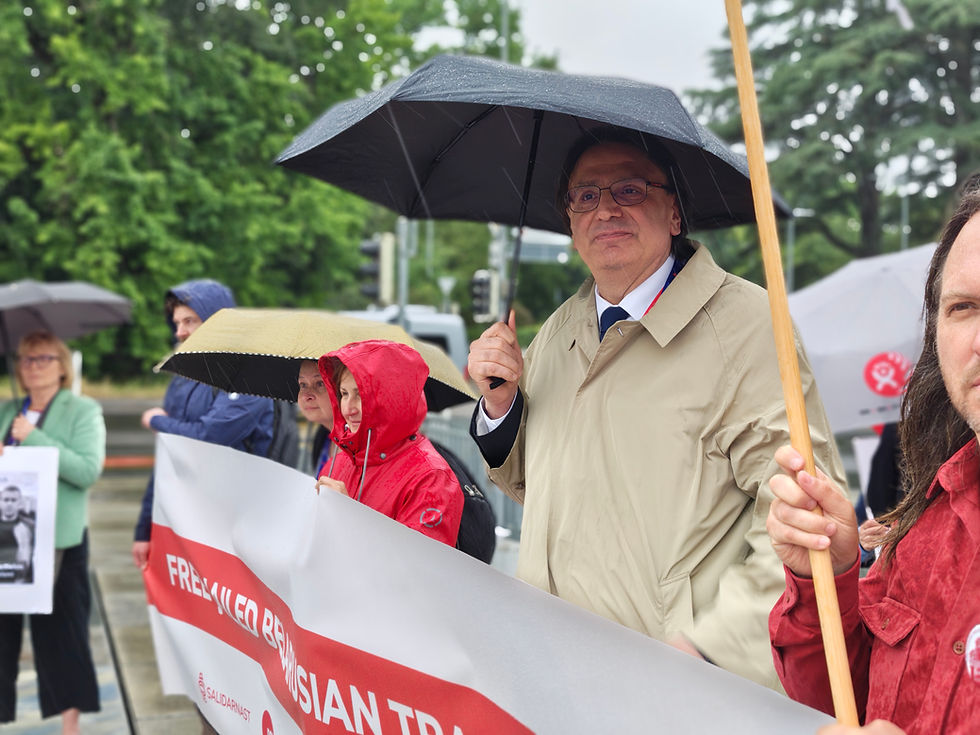
On 6 June in Geneva, during the 114th session of the International Labour Conference, a special meeting on Belarus was held within the Committee on the Application of Standards, concerning the government’s implementation of ILO recommendations in connection with the application of Article 33 of the ILO Constitution.

For the third consecutive year, the “Belarus issue” is being considered within the framework of the application of Article 33 of the ILO Constitution to Belarus. This is only the second instance in the entire history of the International Labour Organisation that Article 33, essentially a disciplinary provision, has been applied. This is due to the failure to comply with two fundamental Conventions, Nos. 87 and 98, which Belarus ratified in 1956.
This year, the debate was no longer about whether the Belarusian government would rectify violations and implement recommendations regarding labour rights abuses, but rather about two entirely incompatible versions of reality.
The ILO Special Envoy to Belarus, Lelio Bentes Corrêa, concluded that after 25 years of monitoring and 13 appearances by Belarus before the committee, what is now being observed is a step backwards and a deadlock rather than progress. He specifically highlighted several key issues: the released trade union leaders Yarashuk and Fiadynich have still not had their passports and pensions returned; more than 50 trade union activists remain under criminal prosecution, with at least 19 in detention; and Vatslau Areshka went blind in prison. He stressed that his mandate is “not political”; it is based on trust and dialogue, but dialogue is only possible when the authorities are actually prepared to discuss the substance of the issues.
The Belarusian government, represented by Aleh Takun, Deputy Minister of Labour and Social Protection, has maintained a familiar stance: Article 33 is allegedly “the most unjust and erroneous decision in the history of the ILO”; Belarus is portrayed as a victim of a “geopolitical game”; and the events of 2020 are claimed to have no connection to trade union rights or social dialogue, as they were supposedly part of an external plot to change the government. According to the government, all arrested trade union leaders are ordinary criminals, and the BKDP is not a trade union but a political group in exile. Regarding the Belarusian issue at the ILO, it is described as merely an ‘information and sanctions war’. Thus, the Belarusian authorities have adopted a position that delegitimises even the raising of the issue.
The second complaint against the ILO concerned allegations of bias towards the pro-government Belarusian Trade Union Federation (FPB). The Belarusian government, FPB leader Yury Senko, and Anatol Nichkasau, representing the employers, all repeated the same argument: the FPB unites around 4 million workers, social partnership is flourishing in the country, tens of thousands of collective agreements have been concluded, unemployment is minimal, and therefore claims about the suppression of independent trade unions are supposedly meaningless. Instead of addressing the question of workers’ freedom of association, they provide statistics on the number of collective agreements, social guarantees, and the FPB’s involvement in law-making. Not a single argument was presented to suggest that the FPB is not integrated into the system of state administration or that it enjoys autonomy.
“The Belarusian delegates refer to facts and the truth, yet at the same time they have refused access to and dialogue with the ILO Special Envoy,” noted Mads Heisel, the workers’ representative from Denmark. “If the truth and facts must be concealed from a neutral observer capable of assessing objective reality, then perhaps there is a reason why the Belarusian ‘truth’ differs from the ‘truth’ of the rest of the world.”
Workers' representatives from other countries consistently emphasised that collective agreements cannot be considered evidence of freedom where there are no independent trade unions and workers are denied the right to organise. The Belarusian authorities had no response to this argument: 22 years have passed since the commission of inquiry's first recommendations, and today there is not a single independent trade union remaining in Belarus outside the FPB.
“The reality is that Belarusian workers have no voice. The reality is that labour leaders and trade union activists are currently in prison in conditions that threaten their lives,” said Kemal Özkan, representing IndustriALL, indignantly.
The Belarusian authorities themselves created the conditions for the expulsion of the leaders and members of independent trade unions, only to then claim that the BKDP ‘does not operate in the country’ – pure cynicism. The FPB’s statement was even harsher: if a trade union remains silent, is integrated into the state, and loses its autonomy, it is no longer a trade union but a state agent.

A standout speech was delivered by Yury Ravavoi, a representative of the Polish NSZZ ‘Solidarność’, who, in essence, challenged the legitimacy of the FPB from an unexpected angle. He described how the Belarusian workers’ delegation included a man from the repressive system, a former security officer, who was later appointed to manage and ideologically control the workers at the Grodno chemical plant. At the international level, the very people who participated in the suppression of independent workers are being presented as ‘workers’ representatives’. Such representatives, in essence, undermine the foundations of tripartism within the ILO.
Equally powerful was the speech by the Dutch workers’ representative, Tjalling Postma: “Workplaces in Belarus have become the main sites of arrests”, while ideological departments and short-term contracts are turning labour relations into a system of fear.
The French workers’ representative emphasised that the destruction of independent trade unions in Belarus has also shattered the entire system of labour relations in the country. The last mechanism of protection against arbitrariness has vanished, replaced by coercion, discrimination, and exploitation. He highlighted that this is now evident not only in the repression of activists, but also in the broader practice of punishing people through labour in labour camps and forced ‘labour therapy’, down to the humiliating conditions faced by political prisoners.
The European Union, Canada, the United Kingdom, Japan, Australia, New Zealand, and allied delegations framed their positions in legal and institutional terms. They believe the problem lies not only in the imprisonment and dismantling of trade unions, but also in Belarus’s systematic disregard for the entire ILO supervisory mechanism. Punishment of trade union activists continues even after their release, through deportations, passport confiscations, and the effective deprivation of people’s rights to documents, pensions, and a normal life.
‘Social dialogue in the country has been destroyed’ because the FPB is dependent on the authorities, and ‘there can be no real return to business as usual’ while independent trade unions are crushed and people remain behind bars. Cooperation with the ILO is possible, but only after concrete steps are taken, not mere pretence or statements about ‘injustice’.
The Kenyan workers' delegate, Dr Davji Atellah, highlighted the recent re-arrest of Ruslan Badamshyn, a Belarusian neurologist and member of the Belarusian Free Trade Union. He emphasised that the authorities do not stop even after a person has been punished: “In Belarus, it is no longer enough simply to serve one’s sentence. The state constantly fabricates new, overlapping charges to ensure that independent voices remain silenced behind prison walls forever.”
In essence, if one examines the positions of the countries involved in this dispute, it is a direct clash between two models of ‘social partnership’. In one, a trade union is an independent workers’ organisation; in the other, it is a state-controlled instrument of discipline within enterprises. Supporting the Belarusian government and the Belarusian Trade Union Federation (FPB) are countries with similar models: Russia, China, Iran, Venezuela, Turkmenistan, and others. The Belarusian authorities are desperately trying to justify the right to a ‘distinctively Belarusian model’, cloaking it in rhetoric about sovereignty, dialogue, and the FPB’s 4 million members. However, the longer this matter is considered, the more evident it becomes that for a significant part of the international community, the issue has already been settled: without independent trade unions, there can be no collective bargaining, no social dialogue, and no proper membership of the international labour community.
And that is precisely why the Belarus case remains so troubling for the Lukashenko regime. It cannot be talked away, made to disappear, or reduced to bureaucratic dust. On the contrary, with each passing year it is becoming more and more of a test of whether the ILO and its members are prepared to defend their own basic principles and values.


Comments