
At the presentation of the Global Rights Index, BKDP reminded the audience of the systemic repression in Belarus
At the presentation in Geneva of the 2026 Global Rights Index, prepared by the International Trade Union Confederation (ITUC), Maksim Pazniakou, Deputy Chair of the Belarusian Congress of Democratic Trade Unions (BKDP), spoke on behalf of the organisation. According to the ITUC presentation, Belarus has once again been placed among the 10 worst countries in the world for workers. The Index records a further deterioration in civil liberties, a rise in the arrest of workers and trade union representatives, and increased pressure on freedom of expression, assembly and association.
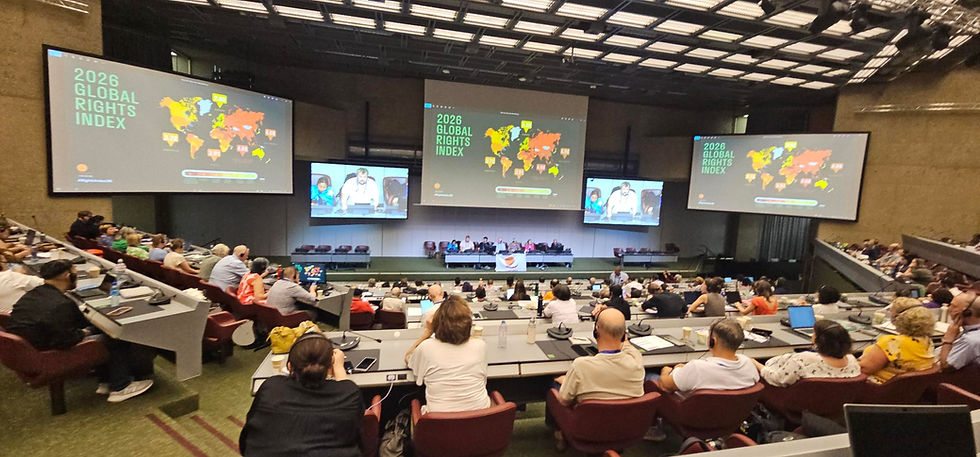
In his speech, Maksim Pazniakou stressed that for BKDP the Index is not merely an international ranking, but evidence of what is really happening to labour rights in Belarus. He recalled that since 2004 the Belarusian authorities have systematically ignored the recommendations of the ILO Commission of Inquiry, and that in 2022 all democratic trade unions were dissolved, which in practice meant the destruction of independent workers’ representation. This was followed by an expansion of forced labour practices.
“Today, social dialogue in Belarus has been replaced by imitation,” said the Deputy Chair of BKDP. “The Federation of Trade Unions of Belarus is part of the state system of governance and control over working people, does not meet the principles of an independent organisation, and does not provide genuine protection of workers’ rights and interests.”
The BKDP representative recalled that in 2023 the ILO applied Article 33 of its Constitution to Belarus, one of the most serious measures within the system of international labour standards. In his words, this amounted to recognition that the violations in Belarus are systemic in nature. He also referred to the findings of the UN Special Rapporteur on Human Rights in Belarus, who has documented politically motivated dismissals, discrimination, restrictions on access to professions, and the persecution of workers for their civic stance.

Maksim Pazniakou also spoke separately about the situation of trade union political prisoners. According to him, dozens of trade union leaders and activists remain in places of detention, while those who have already been released have not been rehabilitated and continue to face restrictions due to criminal records, inclusion on “extremist” and “terrorist” lists, employment bans, and social isolation.
The central message of his speech was made absolutely clear: labour rights in Belarus cannot be separated from human rights.
“One cannot speak of decent work if a worker is afraid to express an opinion. One cannot speak of collective bargaining if an independent trade union is banned. One cannot speak of freedom of association if a person can be labelled an ‘extremist’ for trade union activity.”
From the podium came a call for co-ordinated international action: to work for the release of all trade union activists and political prisoners, to demand the restoration of independent trade unions, to take labour rights violations into account in trade and investment policy, and to support independent trade union and human rights initiatives, including those operating in exile.

As the Index itself underlines, pressure on workers, trade unions and civil liberties is increasing across the world, while attacks on trade union leaders are becoming ever more commonplace.
According to the ITUC, Belarus remains among the 10 worst countries in the world for workers, retaining the category 5 — “no guarantee of rights”. In the country profile, the ITUC stresses that the Belarusian authorities continue the systematic persecution of independent trade unions and trade union activists, while the dissolution of BKDP and its affiliated organisations formed part of a broader campaign to suppress organised labour.
In the ITUC’s assessment, the current global crisis of labour rights is no longer a problem confined to “peripheral” countries, but a challenge to the democratic system as a whole.


Comments